Skip the nonsense — here’s the route.
A lot of survival-crafting guides treat solo and group openings as completely different games.
They’re not. Most of the early priorities stay the same. A few critical ones change hard. Knowing which is which saves time and prevents the usual “we thought more people would make this easier” disasters.
Here’s the practical breakdown.
What stays almost identical
These priorities do not care how many people are in the session:
Identify the primary overnight threat (cold, hostiles, hunger, etc.) and solve it first.
Get the basic tool upgrade that multiplies gathering speed.
Secure a minimum viable overnight spot.
Avoid over-farming materials you cannot yet use or store.
Answer the same core questions in the first 15 minutes (threat, priority resource, safe spot, minimum kit, inventory pressure, visible gate, deliberate ignores).
The logic of early survival is the same. Bodies do not magically remove the need for clean decisions.
What actually changes
1. Labor division vs. sequential work
Solo: you do everything in sequence. Tool → shelter → food → storage.
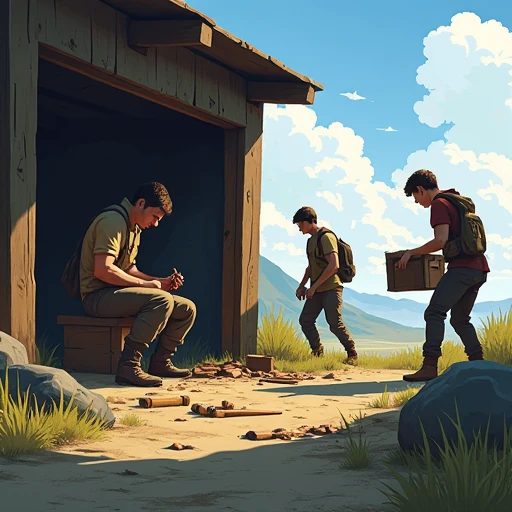
Group: you can parallelize. One person secures the overnight spot while another rushes the first tool upgrade and a third handles early food. This is the single biggest real advantage — if the group actually assigns roles instead of everyone punching the same trees.
2. Inventory and storage pressure
More players fill inventories faster and create storage problems earlier. A group that does not drop a shared storage solution in the first 30–40 minutes will spend the rest of the night dropping items on the ground and arguing about who is carrying the wood. Solo players feel this later; groups feel it almost immediately.
3. Risk tolerance on the first night
Solo: one death can reset a lot of progress or force a long run-back.
Group: a death is usually cheaper. Someone can keep working while another recovers. This lets groups push slightly harder for better positioning or a faster station unlock on night one — provided they don’t all die together in the same bad fight.
4. Crafting station contention
Early stations are bottlenecks. In a group, two people standing at the same workbench wasting time is common. The fix is simple: decide who owns the first crafting queue and have everyone else feed materials instead of competing for the interaction.
5. Information and scouting
Groups can send one person to probe a direction while the others keep the core loop running. Solo players have to choose between scouting and building. This is a real tempo advantage if the group uses it deliberately instead of everyone wandering off.
What people get wrong in groups
Assuming more people means you should build bigger immediately. You should not. The starter base rules still apply; you just reach the “evaluate and possibly move” point faster.
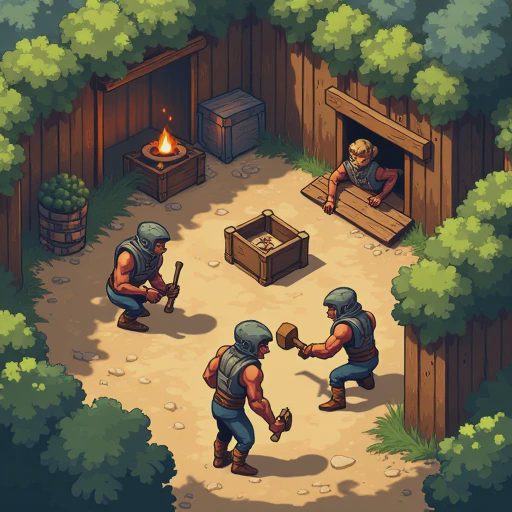
Everyone gathering the same low-tier resource because it feels productive. Assign one primary gatherer for the critical material and rotate.
Skipping the “what are we deliberately not doing” conversation. Groups amplify wasted effort. If three people over-farm fiber you don’t need yet, you just tripled the mistake.
Practical opening templates
Solo
Answer the seven first-15-minute questions.
Rush minimum tool + overnight solution.
Stabilize food and basic storage.
Only then look at the next progression gate.
Group (3–4 people)
Thirty-second role call: who is on shelter, who is on tool rush, who is on food, who is on early storage.
Parallel the minimum viable overnight kit.
Drop shared storage early.
Reassess as a group at the 40–60 minute mark: stay or relocate, and what the next shared craft is.
Bottom line
The opening route does not completely change when you add players. The decision framework stays the same. What changes is execution speed, the cost of mistakes, and the need for explicit coordination.
Solo rewards clean personal priorities.
Group rewards clean role assignment and early shared infrastructure.
Treat the extra bodies as parallel processing, not as permission to ignore the fundamentals. Do that and the first night becomes faster instead of louder.